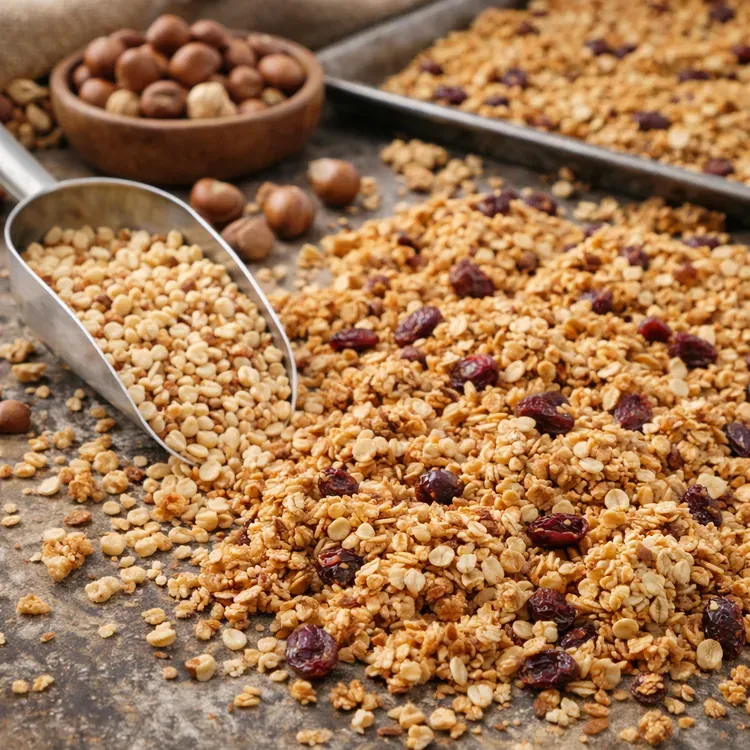
How hazelnut pieces perform in granola lines
Granola is a mechanically demanding product: it is mixed, sometimes baked or toasted, cooled, conveyed, and then packed—often at high speeds.
Hazelnut pieces need to survive handling without excessive breakage and still deliver crisp bite in the final pack.
1) Blend uniformity and segregation control
Differences in density and size between oats, seeds, dried fruit, and nuts can cause segregation during conveying and vibration.
A controlled cut size helps keep hazelnuts evenly distributed, reducing “nut-heavy” and “nut-light” packs.
2) Dust and fines management
Fines accumulate at the bottom of retail packs and can also increase dust in packaging areas.
Setting a dust limit and maintaining it across lots improves pack appearance, reduces product loss, and supports consistent consumer perception.
3) Bake compatibility and roast direction
If your granola is baked after nuts are added, the hazelnut roast level should anticipate additional heat exposure.
Light to medium roast can be preferred where a second heat step occurs, while fully roasted pieces can be used when nuts are added post-bake.
4) Shelf stability in fat-containing inclusions
Nuts are fat-rich ingredients, so oxidation control is a key shelf-life lever. Packaging choice and storage temperature have a measurable impact
on aroma retention, especially in warm climates or extended distribution.
Practical trial tip: Evaluate finished granola at both “typical” and “worst-case” distribution temperatures, and include open-pack handling time
(how long an ingredient bag stays open on the line) in your stability checks.